League Night Lives Here: Inside the Bowling Alleys, Bingo Halls, and Raffle Boards Where America Still Shows Up
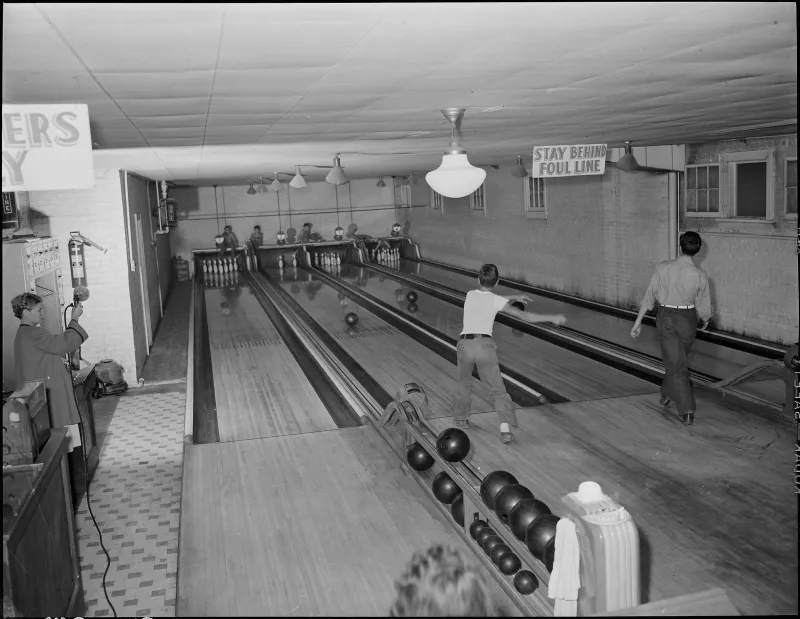
Photo: vintage bowling alley league night players lanes, via i.pinimg.com
The Ball With a Name
Walk into any bowling alley in America on a Tuesday night and you'll hear it before you see it: the rumble of the lane, the clatter of pins, and someone shouting "That's my ball!" — not about a strike, but about a scuffed 12-pounder named Shirley that's been in the house rack since the Clinton administration.
League bowlers don't rent shoes. They have shoes. They don't pick a random ball. They have the ball, broken in over hundreds of frames, its finger holes worn to the exact shape of their grip. And tucked into the corner of most league scoreboards, you'll find the quiet superstition: a jersey number, a birthday, a lane assignment that's "always been lucky."
"I've bowled on Lane 9 for twenty-two years," says Denny, 63, who drives forty minutes every Wednesday to a house outside Dayton, Ohio. "They offered me a different lane once when we had a scheduling conflict. I told them to move the other guys."
Denny is only half joking. That's the thing about numbered games in physical spaces — the numbers stop being numbers. They become territory.
Bingo Night at the Lodge
Forty minutes east of Denny's alley, in a VFW hall with folding chairs and a concession stand selling pull tabs for a dollar, bingo starts at 7 sharp. And bingo, for the uninitiated, is less a game than a liturgy.
Regulars have their daubers — some keep two, a backup for when the ink runs mid-game. They have their seat, their good cards, their rituals for which lucky numbers to mark first. When someone yells a winning pattern on B-11 or N-44, the room knows the caller by the number's nickname before the ball even lands.
The operators of these halls — often volunteers, often veterans themselves — will tell you the game is almost incidental. The hall rents for cheap, the kitchen raises money for the post, and the numbers on the board are just the excuse everyone agreed on to be in the same room at the same time every week.
"People ask me why we don't do it online," one lodge manager in Minnesota told us. "I said, brother, the game takes two hours. The other six days of the week, people call each other about it. That's what we're running."
The Diner Raffle Board
Then there's the humblest version of all: the numbered board behind the register at the small-town diner. Fifty squares, a dollar a square, numbers assigned when the grid fills. When the weekly drawing hits — pegged to the state lottery, usually — the winner gets the pot, and everyone else gets to argue about whether number 23 is cursed.
These boards run on nothing but a marker, a poster board, and trust. No app sends you a notification when your square wins. Someone walks into the diner, someone else tells them, and a conversation starts that has nothing to do with the game itself.
That's the pattern across all three spaces. The number is the hook. The showing up is the point.
When the Games Went Digital
Here's the tension: casual gaming has never been bigger. Millions of Americans play number-based games on their phones every day — quick puzzles, digital daubers, apps that replicate the bingo hall in your palm. The convenience is undeniable, and honestly, we love a good snackable number game as much as anyone.
But for communities that built decades of ritual around arriving, the migration hit differently. A bowling league can't happen asynchronously. A bingo caller doesn't know your grandkids' names. An app doesn't hold your seat.
The pandemic made this brutally clear. When halls and alleys closed, the games moved online easily enough — but the gatherings didn't. Operators describe reopening to half-full rooms, then slowly rebuilding as people realized what they'd missed wasn't the game.
"We lost some leagues for good," admits one alley owner in Wisconsin. "But the ones who came back? They came back mad they'd stayed away. That's how I knew we'd be fine."
What the Number Sanctuary Looks Like Now
The healthiest of these spaces aren't fighting the digital wave — they're borrowing from it. Alleys run hybrid leagues with live scoring apps. Lodges stream bingo for shut-in members who've been coming for thirty years. Diner raffle boards now have group texts so the whole grid knows when the drawing happens.
The formula that survives looks something like this: a numbered game anyone can learn in a minute, a fixed time and place, and a room full of people who'd show up even if they never won. Add a little superstition — a lucky lane, a lucky square, a lucky dauber — and you've got a ritual with a longer shelf life than any app store chart.
There's a lesson in there for those of us who spend our days playing games on screens. The numbers are the same whether they're rendered on a lane scoreboard or a phone display. What the screen can't replicate is the person next to you groaning when your number doesn't hit, and cheering when it finally does.
So here's the 57Mumu Play takeaway: play your quick games, chase your lucky digits, enjoy every minute of pocket-sized fun. But once in a while, find a hall, an alley, or a diner with a board on the wall. Put your name on a square.
The lanes know. They've always known. You just have to show up.